
Drywall Finishing & Taping in Canton, OH
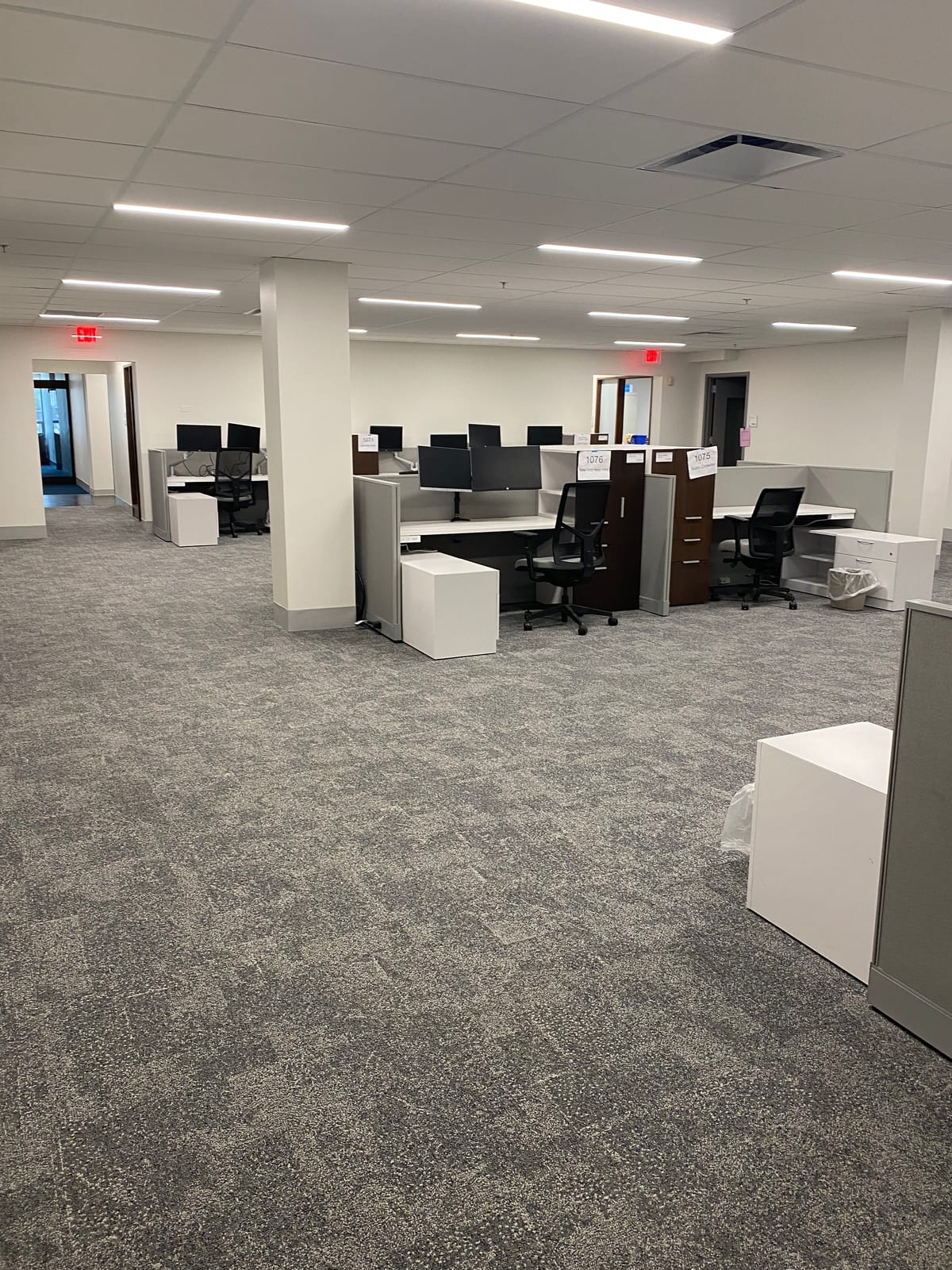
A finish level is not a grade of quality, it is a match between the wall and the light that falls on it. Level 4 covers most Stark County offices and classrooms under flat paint, and Level 5 is what a corridor of windows, a bank of can lights, or a dark or glossy color actually requires so the joints do not show once the room is occupied.
A finish level is not a grade of quality, it is a match between the wall and the light that falls on it. Level 4 covers most Stark County offices and classrooms under flat paint, and Level 5 is what a corridor of windows, a bank of can lights, or a dark or glossy color actually requires so the joints do not show once the room is occupied.
- Owner: 25+ Years in the Trade
- Est. 2012
- Fully Insured & Workers Comp
- OSHA Trained
- MBE Certified
- EDGE Certified
When a Job Needs Level 5, Not Level 4
Most Commercial rooms are correctly specified at Level 4 and never need more. The cases below are where that default is wrong, and where paying for the extra skim coat is cheaper than repainting a wall that failed under its own lighting.
What Drywall Finishing and Taping Includes
How a Drywall Finishing Job Runs
- 01
Walkthrough
We look at the space or the plans in person or by photo, so the scope is based on the real building, not a guess.
- 02
Scope and bid
You get a written scope and a firm bid before any work starts, priced on the actual square footage and conditions.
- 03
Schedule
We set a start date and a sequence that works around your hours, your tenants, or your school calendar.
- 04
Prep
Surfaces are cleaned, repaired, and masked off before a drop of paint or coating goes down.
- 05
Application
Crews apply the coating or material to spec, with the site kept clean and safe throughout.
- 06
Punch list
We walk the finished space with you and close out anything on the list before we call it done.
- 07
Closeout
You get the final walkthrough, any warranty paperwork, and a clean handoff.
We give you a firm, written bid before any work starts, priced on the real scope, not a guess.
What Affects the Cost of Drywall Finishing
| Factor | Why It Moves the Number |
|---|---|
| Finish level | Level 4 is two coats over flat joints and one over corners. Level 5 adds a full skim coat over the entire surface, more material and more labor per square foot. |
| Lighting condition | A room with daylight, can lights, or a non-flat topcoat needs the higher level even at the same square footage as a room that does not. |
| Ceiling versus wall | A gypsum ceiling under recessed lighting is finished to a higher standard than a wall the same lights never graze directly. |
| Substrate condition | New board over new framing finishes faster and more predictably than board patched into an older wall with an uneven plane behind it. |
| Access and ceiling height | Stilts, scaffolding, or a lift add time on a tall Commercial ceiling that a residential-height room never needs. |
| Schedule | Compound needs real drying time between coats; compressing that schedule to hit a GC’s date can add labor to keep pace without shortcutting cure time. |
Drywall Finishing for Stark County Schools and Offices
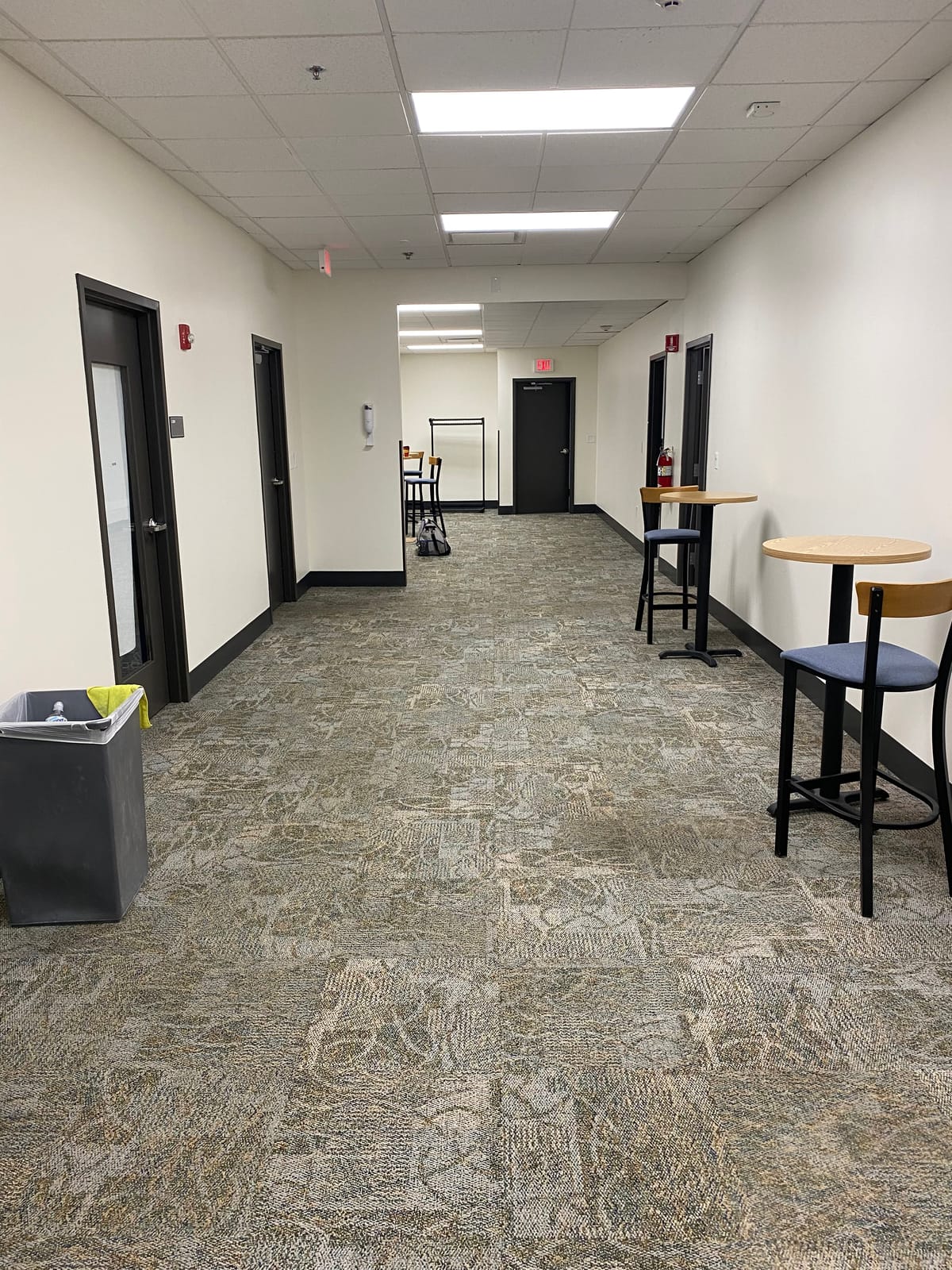
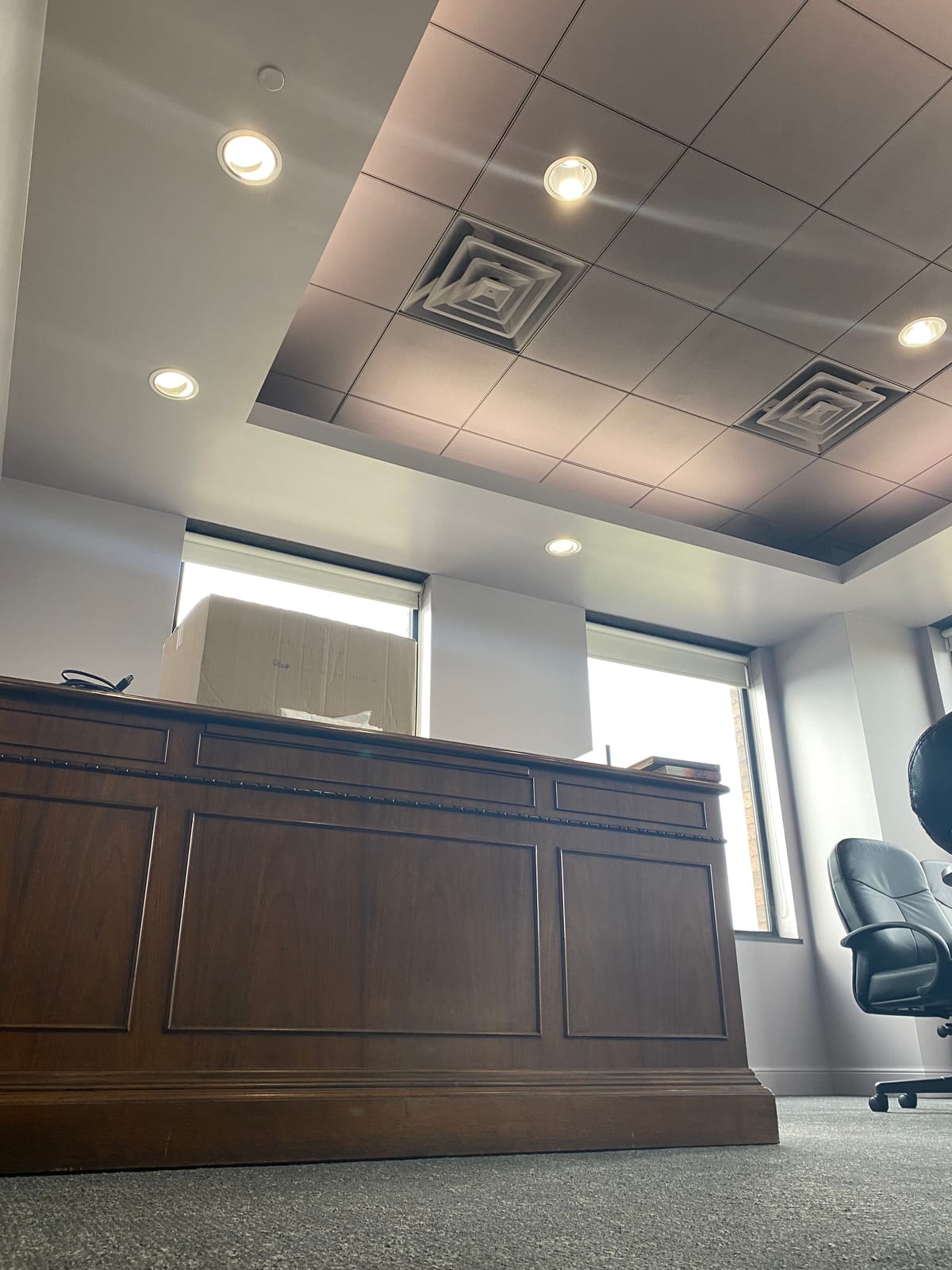
Stark County schools and offices are where the gap between Level 4 and Level 5 actually gets argued, because a written spec that says Level 4 and a room full of exterior glass or a corridor of surface-mounted fixtures are two different instructions pointing in opposite directions. A public school corridor lit by clerestory windows or a bank of LED troffers, or an office suite finished in anything other than flat paint, is exactly the case GA-214 built its own critical-lighting warning around: the spec sheet does not know what the room actually looks like at four in the afternoon.
A wall that passes inspection at 8 a.m. under diffuse morning light and shows every joint at 4 p.m. under a low winter sun raking across it is not a defect that appeared later, it is a finish level that was wrong for the room from the start. That failure mode is common enough on daylit Stark County classrooms and west-facing office suites that the honest answer, before the topcoat goes on, is a mock-up panel or a walk-through under the room’s actual fixtures, not a guess based on the drawing alone.
The primer is where a Level 4 versus Level 5 disagreement usually surfaces first, because ASTM C840 requires a primer before any of these levels and then declines to assign whose scope it is in. On a school or office job that split matters more than on a warehouse, since the paint contractor is the one standing in the finished room when the topcoat reveals whether the wall underneath was actually skimmed to the level the lighting called for, not just the level the purchase order listed.
Specifying up a level costs real money and real schedule days for material and labor that a back-of-house storage room or a windowless interior office will never show a return on. The judgment call is matching the level to the room, not defaulting every wall in a building to the highest spec out of caution, and that call is easier to make correctly when the crew doing the skim coat is the same crew that will be standing next to the client when the paint goes on and the joints either disappear or do not.
Who Owns It When the Paint Reveals a Finishing Defect
A joint that flashes, telegraphs, or shows a ridge line almost never shows up until the topcoat is on, because raw compound and primer both hide small surface variation that a sheen coat does not. That timing is exactly why the split GA-214 describes, drywall on one purchase order and paint on another, turns into a dispute: the trade standing in the room when the defect becomes visible is the paint crew, even when the cause is upstream in how the joint was finished.
The honest answer is a critical-lighting check before the first coat of primer goes on, not after the topcoat exposes the problem. On a job where the same crew finishes the board and carries it through paint, that check happens as one continuous decision instead of a call placed between two separate contractors after the room is already occupied.
Why Canton Buyers Choose Straight Line
A level of finish is a decision about the room’s lighting, not a box to check on a bid form, and we would rather walk a client through why a corridor needs Level 5 before the skim coat than explain a flashing joint after the paint is dry. - Duane R. Harris, President
Straight Line Painting is a Commercial painting contractor in Canton built on structure, systems and service, insured, OSHA certified, MBE and EDGE certified.
Related Work
Drywall Contractor
Metal stud framing, hanging, finishing and repair, plus combined drywall-and-paint packages from one crew.
Read moreDrywall hanging
Commercial hanging on metal stud framing, one crew carrying it through to finish.
Read moreDrywall repair
Patch to full panel, blended into the existing wall of older Canton Commercial interiors.
Read moreCommercial drywall packages, metal stud, hang, finish, and paint combined
Metal stud, hang, finish and paint under one contract for Stark County new builds.
Read moreReal Projects, Real Buildings
- Affordable Dentures & Implants
- Buffalo Wild Wings
- Blossom Hill Adult Daycare
- Church of The Western Reserve
- University Hospitals Ahuja Medical Center
- AutoZone
- Dollar General
- Dunkin'
Request a Bid
Got it. We're on it.
Your request is in. Our office will follow up to schedule a walkthrough or price it from what you sent.
Drywall finishing and taping Questions Canton Buyers Ask
What is a Level 5 finish and do we need it?
A Level 5 finish is a full skim coat of joint compound over the entire drywall surface, not just the joints and corners, applied on top of the standard taping and finishing coats. Most Stark County offices and classrooms under flat paint do not need it and are correctly spec'd at Level 4. A room lit by a wall of windows, finished in a non-flat sheen, painted a dark or saturated color, or lit by surface-mounted fixtures aimed across the wall is where Level 5 earns its cost, because that is exactly the condition that shows every ridge a lower level would hide.
The spec says Level 4, but I am worried about the lighting. What do we do?
Walk the room under the actual fixtures, or under a mock-up panel finished both ways, before primer goes on rather than after the topcoat reveals it. A written spec cannot always predict how a specific run of windows or can lights will rake across a specific wall, and that check costs far less than repainting a wall that fails under its own lighting after occupancy.
Why does a wall look fine in the morning and show every joint in the afternoon?
Low-angle light rakes across a surface instead of falling on it straight down, which turns a ridge invisible under diffuse overhead light into a visible shadow line. A west-facing Stark County office or classroom with a run of windows sees this daily as the sun angle changes, which is why the finish level has to be matched to the room’s actual light, not just its square footage.
What does the primer have to do with the finish level?
ASTM C840 requires a primer before Level 3, 4, or 5 decoration and then says explicitly that assigning that primer to a specific trade is not the intent of the standard. GA-214 answers the question the standard leaves open by putting the primer inside the paint specification, a different purchase order than the drywall finishing scope, which is exactly where a finish defect gets argued between two separate contractors instead of caught before paint.
If the paint shows a defect, is that a drywall problem or a paint problem?
It is usually a drywall finishing problem that only becomes visible once the topcoat is on, since raw compound and primer both hide small surface variation that a paint sheen does not. That is the argument for one crew carrying finishing through paint: the check for it happens before the first coat of primer, not after the client is standing in a finished room looking at a flashing joint.
Is it worth paying to specify a room up a level?
Only where the room’s lighting or sheen actually calls for it. A back-of-house storage room or a windowless interior office under flat paint gets no visible benefit from a Level 5 skim coat and just adds material and labor cost. A daylit lobby, a glossy boardroom wall, or a corridor under surface-mounted fixtures is where the extra coat pays for itself the first time the sun crosses the room.
Ready to Get a Bid?
Tell us about the job and we will schedule around your hours.
Straight Line Painting LLC
1145 High Ave SW, Canton, OH 44707
Monday-Friday, 8:00 AM - 4:00 PM