
CMU & Block Wall Painting in Canton, OH
Straight Line Painting fills, primes, and coats CMU and cinder block on Stark County plants, schools, and gyms, using a block filler to close the pore structure and a primer built to tolerate fresh masonry's high pH before any topcoat goes on. Bare block is not a wall you can roll paint straight onto and get a finish that lasts, and most of the block repaints we get called to are a first attempt that skipped a step and starved out early.
Straight Line Painting fills, primes, and coats CMU and cinder block on Stark County plants, schools, and gyms, using a block filler to close the pore structure and a primer built to tolerate fresh masonry's high pH before any topcoat goes on. Bare block is not a wall you can roll paint straight onto and get a finish that lasts, and most of the block repaints we get called to are a first attempt that skipped a step and starved out early.
- Owner: 25+ Years in the Trade
- Est. 2012
- Fully Insured & Workers Comp
- OSHA Trained
- MBE Certified
- EDGE Certified
Signs Your Block Wall Needs Real Prep, Not Just a Recoat
Block wall failures look like paint problems and are almost always substrate problems. What actually shows up on the wall tells you whether the fix is a simple recoat or a full filler-and-primer redo.
What Block Wall Painting Includes
How a Block Wall Painting Job Runs
- 01
Walkthrough
We look at the space or the plans in person or by photo, so the scope is based on the real building, not a guess.
- 02
Scope and bid
You get a written scope and a firm bid before any work starts, priced on the actual square footage and conditions.
- 03
Schedule
We set a start date and a sequence that works around your hours, your tenants, or your school calendar.
- 04
Prep
Surfaces are cleaned, repaired, and masked off before a drop of paint or coating goes down.
- 05
Application
Crews apply the coating or material to spec, with the site kept clean and safe throughout.
- 06
Punch list
We walk the finished space with you and close out anything on the list before we call it done.
- 07
Closeout
You get the final walkthrough, any warranty paperwork, and a clean handoff.
We give you a firm, written bid before any work starts, priced on the real scope, not a guess.
What Affects the Cost of Block Wall Painting
| Factor | Why It Moves the Number |
|---|---|
| Coverage rate on bare block | Block's porous, textured surface takes more material per square foot than drywall does, in the filler coat and often the topcoat, before labor even enters the number. |
| Block filler vs. filler-and-primer system | A wall needing a full high-build filler pass before priming takes more labor and material than one needing only spot patching and a primer. |
| Surface condition and prior coatings | Spalled block, failed mortar joints, or a prior coating that has to be removed rather than coated over changes the prep scope before the new coat goes on. |
| Interior vs. exterior exposure | An interior gym or plant wall with no bulk water exposure is a different, usually less costly, coating decision than an exterior wall carrying wind-driven rain and freeze-thaw. |
| Topcoat system | A standard acrylic topcoat and an elastomeric system are priced and applied differently, and the choice depends on the wall's exposure, not just the look you want. |
| Application method | Spray-and-backroll covers a large block run faster than roller-only, but occupancy, ventilation, and overspray control can rule spray out on some jobs. |
| Height and access | A gymnasium wall running to a high ceiling or a plant wall behind racking adds lift or scaffold cost a ground-level shop wall does not carry. |
| Occupied vs. empty building | A school or gym still in session, or a plant running production, adds phasing and off-hours labor an empty building does not. |
Block Wall Painting in Canton and Stark County
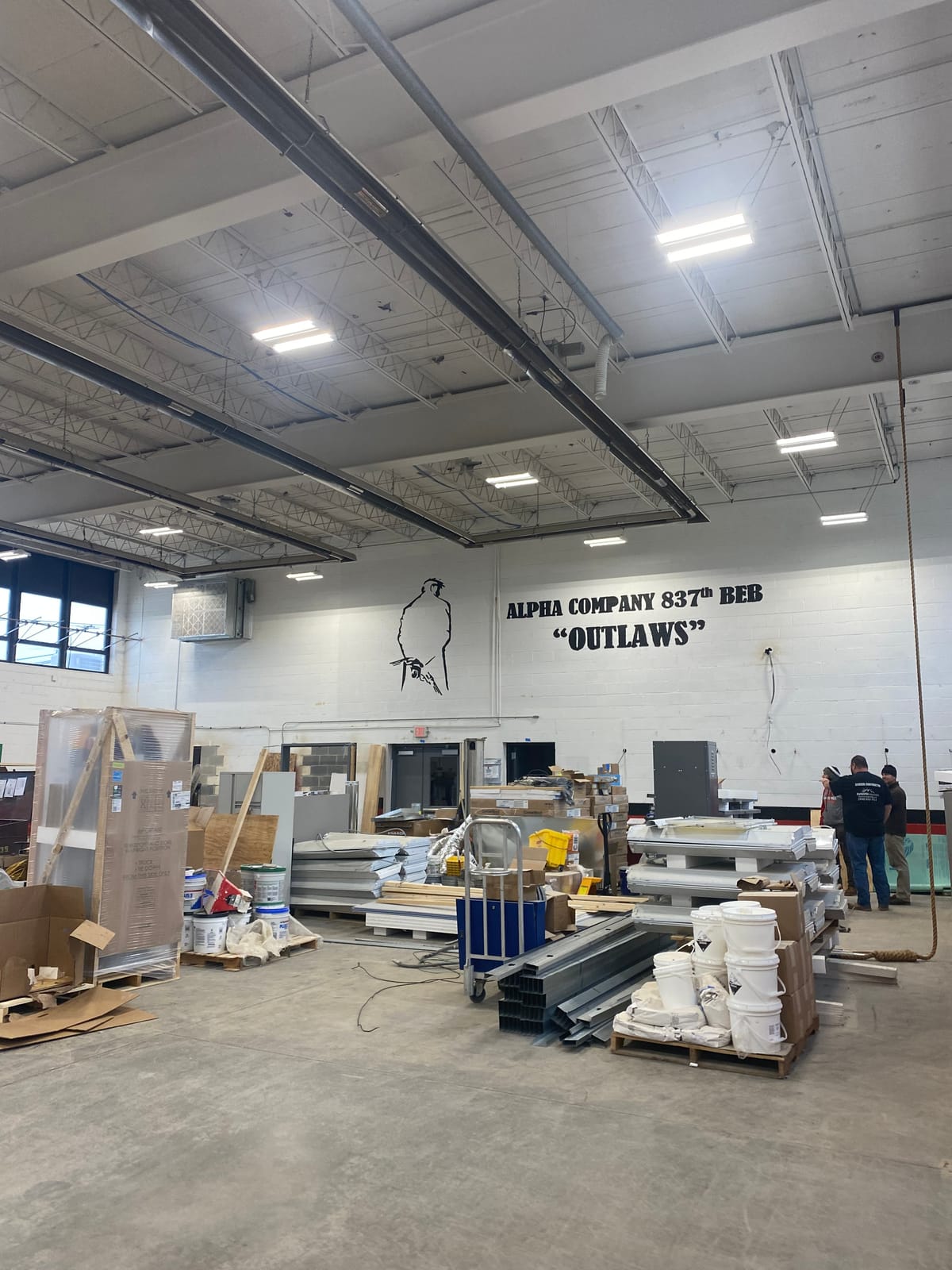
Stark County built a lot of its plants, school gyms, and armories in CMU because it is cheap, structural, and fast to lay, and that stock is old enough now that most of it is on its second or third repaint. We see it constantly: a school gym addition, a shop building, or a plant expansion where the block was never filled correctly the first time, and every repaint since just added another thin coat over a surface that was starved from the start. The Wooster Armory drill hall shows what that block-built stock looks like inside, painted white CMU running floor to a high steel deck, the kind of wall a gym, a plant floor, or an armory across Stark County is built out of.
Fresh or recently laid block is a different job than a decades-old wall, and the difference is chemistry, not cosmetics. Portland cement mortar and new masonry units carry a high pH while they cure, high enough to attack an ordinary latex primer and cause it to fail or blister before it ever bonds. A new gym addition or plant expansion built this construction season needs a cure window before painting and a primer rated for that alkalinity, not the same primer you would use on a wall that finished curing years ago. Skipping that step is the single most common reason a brand-new block wall fails within its first year.
Efflorescence is the wall telling you something about moisture, not a cosmetic defect to paint over. Those white, powdery salt deposits form when water moves through the block, dissolves soluble salts in the mortar, and carries them to the surface where the water evaporates and leaves the salt behind. Painting over it without addressing the moisture path just traps the problem under a film that will fail again, often faster. On an exterior Stark County wall, that moisture path is usually grade, downspouts, or flashing, not the paint itself, so we look at where the water is coming from before recommending a coating system.
Interior and exterior block get different systems for a reason. An interior gym, shop, or plant wall mostly manages humidity and surface wear, so a standard acrylic or epoxy system over a properly filled and primed wall holds up well. An exterior wall through a Northeast Ohio winter manages wind-driven rain and freeze-thaw cycling, which is where elastomeric topcoats earn their keep: a flexible, crack-bridging film that moves with the wall and sheds water. The tradeoff is real, though. An elastomeric film applied over a wall that needs to breathe moisture outward, particularly one with an interior moisture source, can trap that moisture instead and cause blistering from the inside out. That is a judgment call we base on the wall's condition and history, not a default we apply to every exterior block building.
Spray-and-Backroll vs. Roller-Only on Block
A roller can carry primer or topcoat onto block, but it tends to bridge across the surface texture and mortar joints instead of driving material into them, the same starved look that shows up as early failure. Spray-and-backroll, spraying the coating on and working it into the surface with a roller before it sets, gets material into the pores and joints a roller pass alone leaves thin, and it covers a large block run faster. Roller-only still has its place: small walls, occupied spaces where overspray control matters, or touch-up areas where spray equipment is not worth setting up. We choose the method by the wall and the building, not by default.
Why Canton Buyers Choose Straight Line
A block wall repaint costs more per square foot than a drywall room, and the reason is coverage rate on a porous surface, not a padded margin. Fill it, prime it right for its pH, and it holds; skip either step and you are painting it again in a year. - Duane R. Harris, President
Straight Line Painting is a Commercial painting contractor in Canton built on structure, systems and service, insured, OSHA certified, MBE and EDGE certified.
Related Work
Industrial Painting
Warehouse, plant and metal-building coatings, including dryfall ceilings and rust remediation, without stopping production.
Read moreMetal building and siding repainting with rust remediation
Rust remediation before recoat, not paint-over, on freeze-thaw and road-salt corroded metal-clad buildings.
Read moreWarehouse painting
Ceiling deck and racking work around live inventory in Massillon and I-77 corridor distribution centers.
Read moreInstitutional Painting
Schools, churches and occupied hospitals, scheduled around calendars and shifts, MBE and EDGE certified.
Read moreReal Projects, Real Buildings
- Affordable Dentures & Implants
- Buffalo Wild Wings
- Blossom Hill Adult Daycare
- Church of The Western Reserve
- University Hospitals Ahuja Medical Center
- AutoZone
- Dollar General
- Dunkin'
Request a Bid
Got it. We're on it.
Your request is in. Our office will follow up to schedule a walkthrough or price it from what you sent.
CMU and block wall painting Questions Canton Buyers Ask
What primer does cinder block need?
Cinder block and CMU need a primer rated for high-pH, alkaline masonry, not a standard latex primer, because fresh mortar stays alkaline enough while curing to blister or fail an ordinary primer. That primer goes on after a block filler has closed the surface's pores and joints, not directly onto bare block. On new or recently laid masonry, we also check the wall has cleared its cure window first; painting too early is one of the most common reasons a new block wall fails within its first year.
Why does block need a filler coat before paint?
Bare CMU is full of surface pores and rough mortar joints an ordinary paint film cannot bridge on its own. Skip the filler and the topcoat goes on thin, looks starved right after it dries, and fails early because it never had a sealed, uniform surface to bond to. A block filler, a high-build coating applied before primer, closes those pores and joints so everything after it has a real surface to hold onto.
What is that white powdery deposit on our block wall, and can you just paint over it?
That is efflorescence, soluble salts carried to the surface by water moving through the block and left behind when the water evaporates. It is a sign of moisture movement, not surface dirt, and painting over it without addressing the source just traps the problem under a coating that will fail again, often faster. We remove it as part of prep and look at where the water is coming from before recommending a system.
Should an exterior block wall get an elastomeric coating?
Often, but not automatically. Elastomeric topcoats are flexible and crack-bridging, which helps an exterior CMU wall handle Northeast Ohio's freeze-thaw cycling better than a standard acrylic. The tradeoff is an elastomeric film can trap moisture in a wall that needs to breathe it outward, particularly one with an interior moisture source, and cause blistering from the inside instead of solving the problem. We base that call on the wall's exposure history, not a blanket rule.
Why does painting a block wall cost more per square foot than painting drywall?
Coverage rate, not margin. A porous, textured CMU surface absorbs and requires more filler and often more topcoat per square foot than smooth drywall does, and a wall needing a full block filler pass before priming carries real material and labor cost before the color coat goes on. A smooth, well-coated block wall due for a routine recoat costs less than a bare or failing wall that needs filler and a full primer system.
Does new construction block need different treatment than an older repaint in Stark County?
Yes. New or recently laid block and mortar are still curing and carry a high pH that can attack a standard primer, so a new school addition or plant expansion needs a cure-window check and an alkali-resistant primer before anything else goes on. An older Stark County block wall that finished curing years ago does not carry that chemistry risk, but it may carry its own issue, like a prior coating that was never filled correctly and is already failing.
Ready to Get a Bid?
Tell us about the job and we will schedule around your hours.
Straight Line Painting LLC
1145 High Ave SW, Canton, OH 44707
Monday-Friday, 8:00 AM - 4:00 PM